Traditional family order and female autonomy
A Pale View of HillsTraditional family order and female autonomy emerge as a contested question of who may choose a woman’s home, work, marriage, and political convictions. Through conversations about adult children living apart from parents, women’s changing habits, and Niki’s refusal to treat marriage as life’s necessary destination, the novel places inherited authority beside claims to individual choice. The contrast is not a clean passage from oppression to freedom: older characters sometimes accept new arrangements in one part of life while defending male guidance in another, and Etsuko’s recollections make even her own earlier position uncertain.
Separate households and inherited authority
Ogata-San describes the family of Old Watanabe as ruled by a war-lord, reporting that the younger couple regularly complain about how intolerable the older man has become. Although he says he personally likes Watanabe, he recognizes that the couple might want an apartment of their own. He treats young couples living apart from parents as an increasingly common arrangement, and interprets it as a rejection of old men ruling younger people indefinitely. His language makes household separation more than a matter of convenience: it marks a shift in who has the authority to govern a family’s daily life.
Ogata-San’s comments are significant because he is himself an older man and a father. He can describe younger people’s resistance to patriarchal control without presenting himself as wholly outside the older generation. His own new house is compact, and he says the Nagasaki house had been too large for one old man. The smaller home offers a practical counterpart to his discussion of young couples living independently, though he does not explicitly equate his move with their reasons. The scene holds both positions together: family members may value connection across generations, while a shared household can also concentrate authority in the older generation.
The discussion also recalls Etsuko’s early married life with Jiro. She tells Niki that, in those days in Japan, it was still expected that a couple would live with the husband’s father, and that there had been arguments because Jiro did not want to do so. Etsuko initially says she would have been happy to live with her widowed father-in-law and insists that she was fond of him. Yet she then allows that Niki may be right that she was relieved not to have him move in, adding that she cannot remember clearly. Her account resists a simple division between dutiful acceptance and private opposition: affection, custom, marital disagreement, and possible relief coexist, while memory leaves her final position unresolved.
Modernity, gender, and authority
At a gathering with Mrs. Fujiwara, Ogata-San and his companion frame women’s changing preferences as evidence of a rapid social transformation. Mrs. Fujiwara says she has tried to find a wife for her son but is struck by how different young women are now. Ogata-San agrees, associating their independence with talk of washing machines and American dresses. Their examples make modernity visible in ordinary domestic choices and consumer goods, but their tone also marks those choices as a challenge to older expectations of women’s conduct.
Ogata-San’s election anecdote sharpens the issue from household habits to political agency. He recounts hearing about a colleague of Jiro’s whose wife disagreed with him over which party to support. The husband beat her, but she still refused to give way; they ultimately voted for different parties. Ogata-San presents this outcome as extraordinary compared with the old days. The story exposes a stark contradiction: a husband attempts to enforce obedience through violence, yet the wife retains her separate judgment. The reported incident is not evidence that the conflict has disappeared; it makes the costs of exercising autonomy plain even as separate votes become imaginable.
Marriage, motherhood, and the right to choose
The older ideal of female dependence appears more directly when an old woman urges Sachiko to return. She argues that a woman should not be without a man to guide her and warns that harm can come of such a situation. She invokes her ill father, whose life is not in danger, as a reason for Sachiko to come back, but also presents the return as necessary for Sachiko’s own wellbeing. Her offer of hand-knitted cardigans for Sachiko and Mariko lends practical warmth to an appeal that would restore the women to a household structured around the older generation. Care and control are intertwined: the concern may be sincere, but the proposed solution places female security under male guidance.
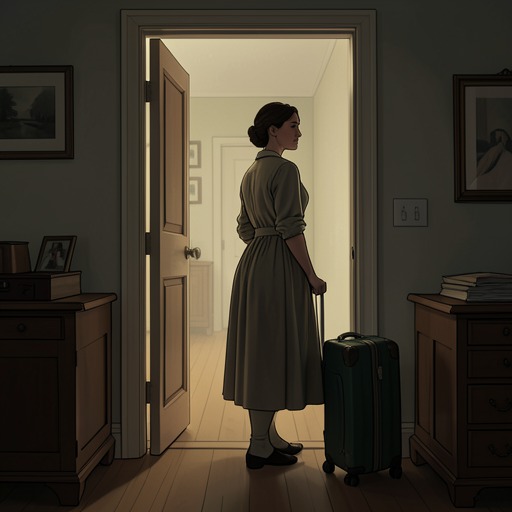
Niki challenges a different expectation when Etsuko asks whether she plans to marry. She rejects the premise that marriage needs justification, and objects to the idea that women have been persuaded that marriage and children are all life can offer. As she packs, she insists there are many other things she could do and does not want to become confined with a husband and children. The physical struggle to shut her suitcase accompanies a verbal refusal to accept a prescribed future. Her objection is not merely to a particular match; it is to marriage and motherhood being treated as the natural, exhaustive measure of a woman’s life.
Etsuko responds by telling Niki that she must live as she thinks best and says she is not ashamed of her. That acceptance, however, sits beside her later suggestion that there is not much else in the end, and her earlier questions about marriage. Their exchange therefore registers both support and generational distance: Etsuko grants Niki the choice she is defending, but does not wholly share Niki’s rejection of marriage as a central life possibility.
Contradictions and the limits of change
The novel’s treatment of female autonomy gains force from these partial, sometimes conflicting positions. Ogata-San recognizes that young couples may need freedom from an overbearing father, yet joins the criticism of women who are headstrong. The old woman offers gifts and expresses concern for Sachiko, while defining a woman’s wellbeing through male guidance. Etsuko remembers affection for her father-in-law but cannot rule out that she was relieved not to live with him. None of these moments reduces family attachment to simple coercion or independence to uncomplicated liberation.
Niki’s argument makes the generational contrast most explicit, but the older scenes give that argument a history: decisions about residence, domestic work, marriage, and voting all test whether women and younger couples may act as separate persons within family life. The result is a picture of changing norms in which old authority remains audible even when its arrangements are questioned. Autonomy appears not as a settled condition but as the contested ability to choose, disagree, and live outside a role that others regard as proper.